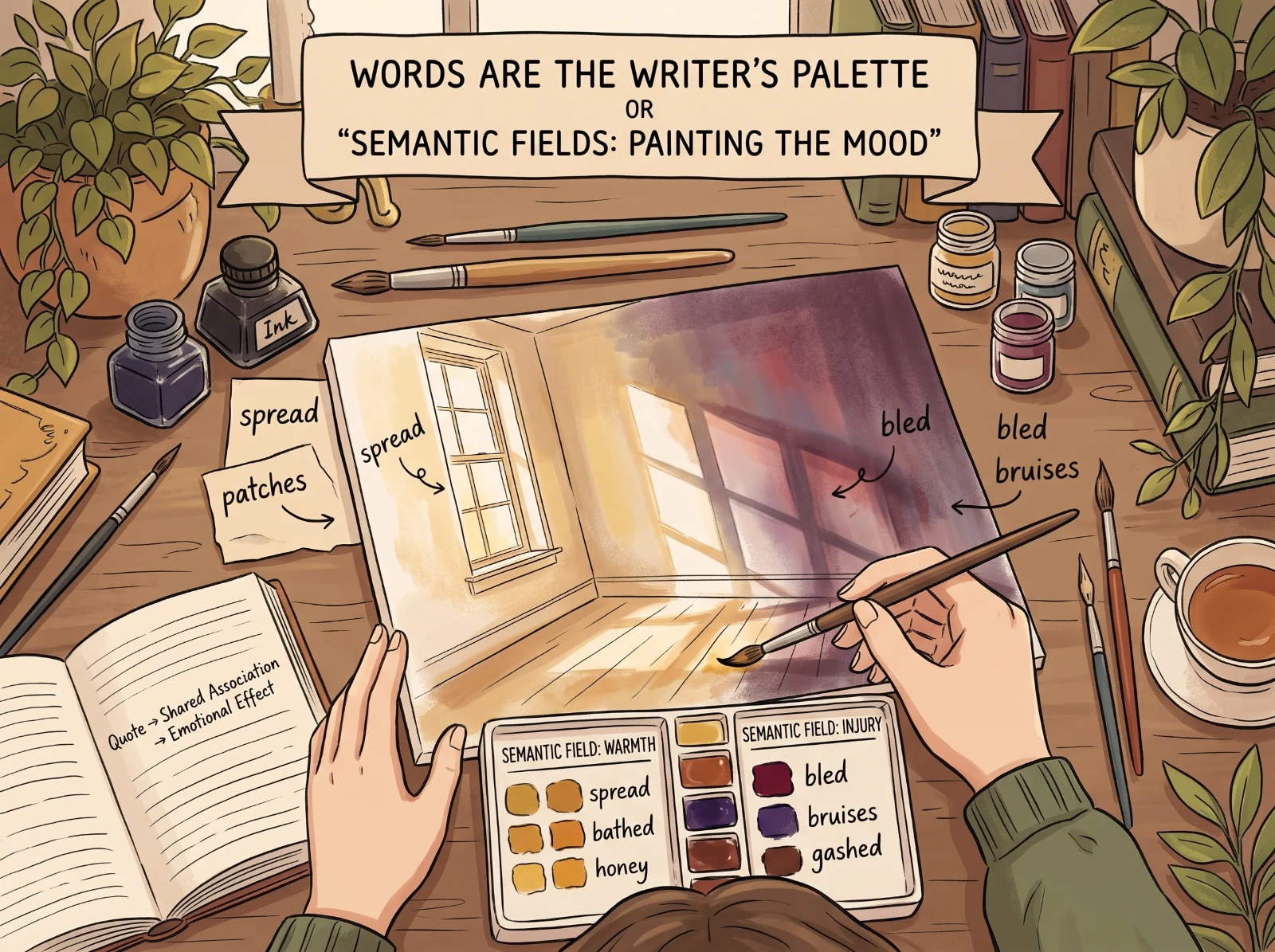
Imagine walking into an empty room on a quiet morning.
The window is open, the air is still, and daylight streams through the glass. Now consider this simple description:
"Sunlight spread across the carpet. Pale patches of colour marked the wall.”
The setting feels tranquil, expansive, and warm. You can almost feel the gentle morning air against the floorboards.
Now read the same scene again. Nothing about the physical layout has moved; the carpet is the same, the walls are identical, and the sun continues to shine:
“Sunlight bled across the carpet. Pale bruises of colour marked the wall.”
The atmosphere immediately shifts. The warmth evaporates, replaced by a subtle, creeping unease. You find yourself looking around the room with suspicion, waiting for something terrible to happen.
Yet, only two words changed.
How can two minor lexical substitutions alter the entire psychological temperature of a space? The answer lies in one of the most powerful—and frequently misunderstood—tools in literature: the semantic field.
What Is a Semantic Field, Really?
In IGCSE and IB English exams, examiners see the term "semantic field" used constantly, but rarely with genuine analytical control.
Students often treat a semantic field as if it were simply a collection of synonyms or a fancy label for a list of words. But a semantic field is not a thesaurus entry. A semantic field is a network of words linked by a common domain of meaning or shared cultural association.
In our second example, notice the pair we swapped in:
- spread -> bled
- patches -> bruises
Neither bled nor bruises is synonymous with spread or patches. What they share is a semantic field of physical trauma, injury, and violence.
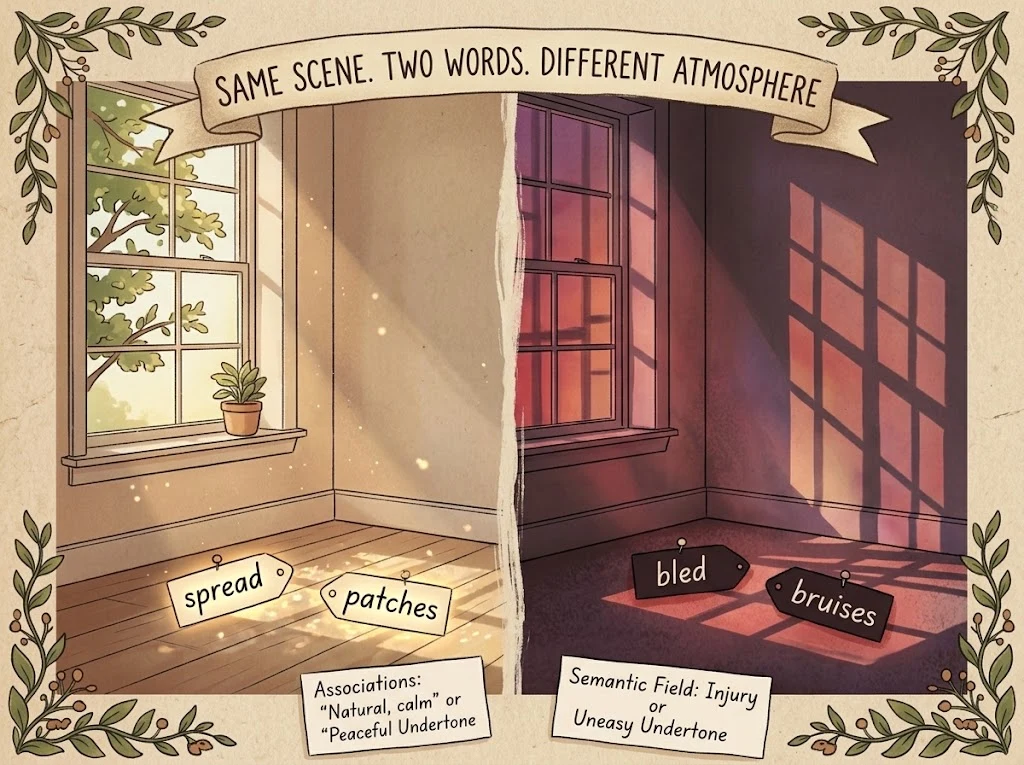
When a writer introduces isolated words from the same conceptual family, our brains subconsciously string them together. One word hints at a concept; two or three begin to establish an underlying emotional current. Even if the narrator never explicitly mentions danger, our subconscious is already on alert.
Context First: Avoiding the "Danger" Fallacy
When analyzing a semantic field in an exam essay, many students fall into a common analytical trap. Upon seeing words like bled and bruises, they immediately jump to an absolute conclusion:
“The writer uses a semantic field of injury, which shows that someone has died and danger is everywhere.”
Examiners penalize this kind of analysis because it ignores the fundamental rule of literary technique: context matters.
Look carefully at what the words are actually describing in the sentence:
- "Bled" describes the gentle movement of sunlight
- "Bruises" describes the pattern of colour on plaster
There is no corpse on the floor, nor is there assailant hidden in the wardrobe. The text is simply describing light entering through a window.
The literary power of this passage doesn't come from proving literal danger. It comes from the cognitive friction between the subject and the language:
- The Subject: An ordinary, inanimate domestic morning.
- The Vocabulary: Terms laden with human vulnerability, pain, and bodily harm.
By casting the vocabulary of living tissue and trauma across a harmless domestic interior, the writer generates an uncanny, threatening undertone. It implies that the space itself is contaminated, wounded, or hostile. Top-band analysis doesn't just name the field; it explains the emotional resonance created when that field is applied to this specific subject.
Joining the Dots: The Grade 9 Analytical Formula
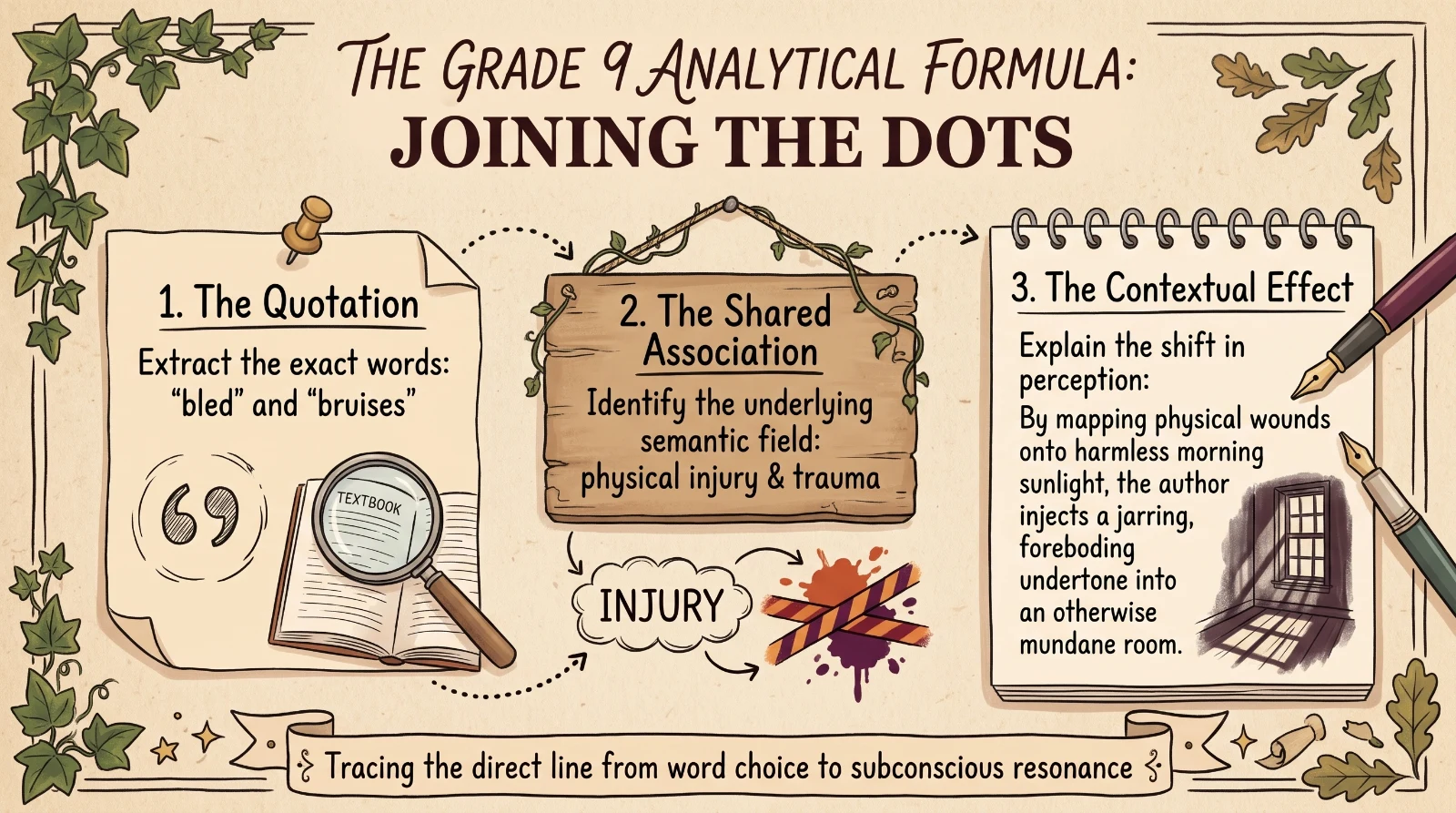
To move past generic comments like "this creates vivid imagery" or "this shows a negative atmosphere," your analysis must trace the explicit line from the word choice to its subconscious resonance.
Use this three-step blueprint in your next analytical essay:
Quote -> Shared Association -> Contextual Effect
Putting It Together in an Essay Paragraph
- The Grade 5 Approach (Surface Summary):
"The author uses words like 'bled' and 'bruises' which shows that the room is dangerous and makes the reader feel scared."
- The Grade 9 Approach (Close Reading):
"The writer subtly destabilizes the domestic setting through a semantic field of physical trauma, employing 'bled' and 'bruises' to describe the morning light. Rather than portraying the room as an objective space, the language maps bodily vulnerability onto an inanimate interior, imbuing ordinary sunlight with an uneasy, predatory quality that foreshadows lurking psychological tension."
The Writer’s Palette: Try It Yourself
Semantic fields are not just analytical devices for reading; they are the pigments writers use to tint a scene without ever having to announce what they are doing.
Take our original room and test how different semantic fields alter its reality:
“Sunlight ________ across the carpet. Pale ________ of colour marked the wall.”
1. The Semantic Field of Decay / Abandonment
- Pair: crept (verb) + scabs (noun)
- “Sunlight crept across the carpet. Pale scabs of colour marked the wall.”
- The Effect: The room feels unkempt, aged, and neglected, turning daylight into something secretive and diseased.
2. The Semantic Field of Royalty / Sacred Luxury
- Pair: draped (verb) + crowns (noun)
- “Sunlight draped across the carpet. Pale crowns of colour marked the wall.”
- The Effect: The empty room transforms instantly into something stately, quiet, and revered, as if the light itself were an expensive, ceremonial fabric.
3. The Semantic Field of Ocean / Water
- Pair: rippled (verb) + tides (noun)
- “Sunlight rippled across the carpet. Pale tides of colour marked the wall.”
- The Effect: The floor feels fluid, luminous, and weightless, giving the interior a breezy, aquatic calmness.
Reading between the lines means noticing how an author steers your imagination before you even realize you've been turned. When you look at an exam extract, stop hunting solely for metaphors and similes. Look closely at the quiet verbs and everyday nouns working together across the paragraph.
The physical facts of a story tell you what is happening on the surface. But the semantic fields chosen by the writer tell you what the world truly feels like underneath.
Put It Into Practice
Now it’s your turn: replace “spread” and “patches” with a new past-tense verb and plural noun from a single semantic field. Keep the room and events identical. What mood do your two chosen words create?