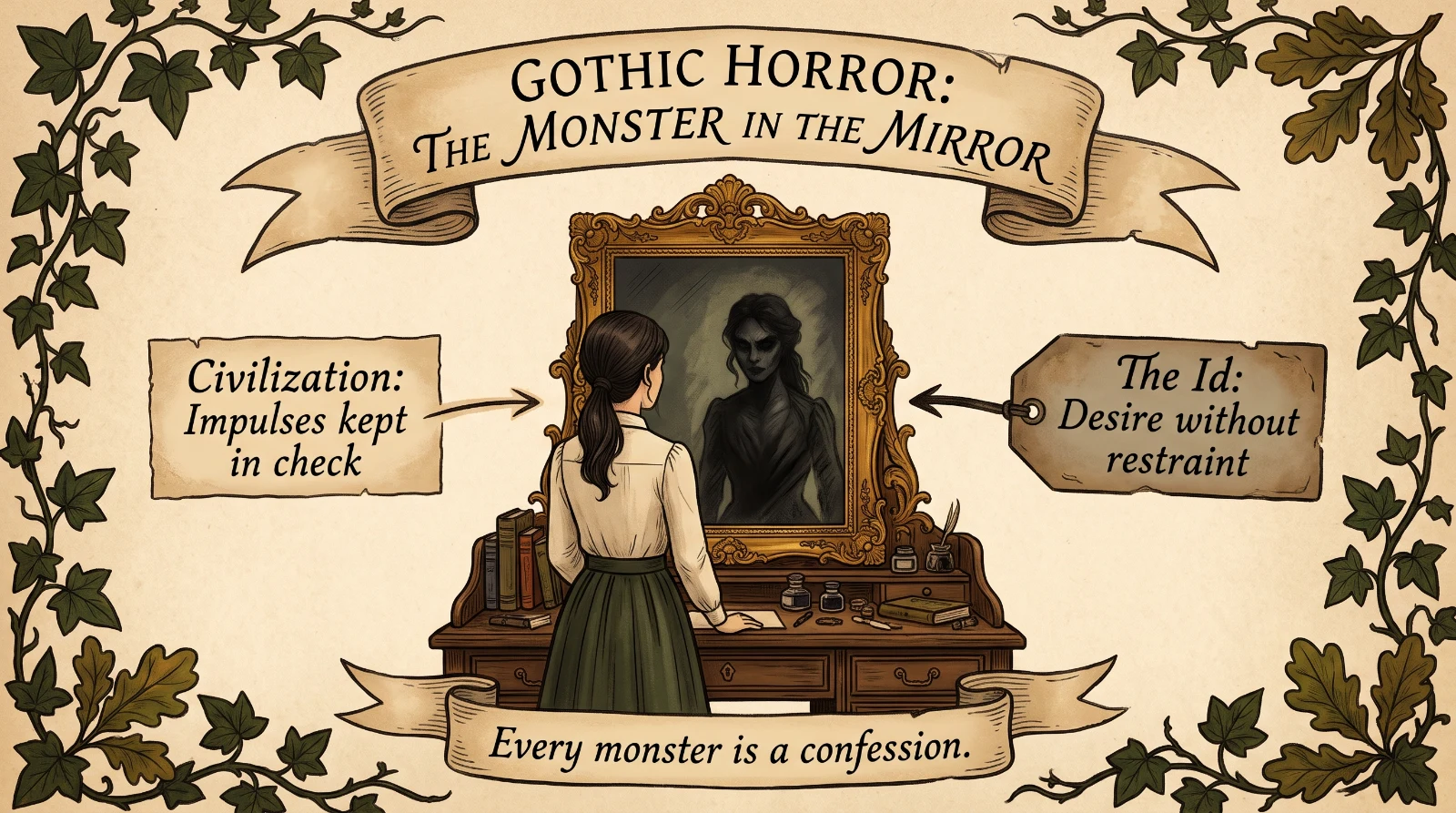
What if the most terrifying monster in Gothic fiction isn't hiding under your bed? What if it's looking back at you in the mirror?
Gothic literature has a rather inconvenient habit of making monsters look suspiciously like ourselves. When students analyze the Gothic genre, they often focus on the isolated settings, the creeping fog, or the supernatural jump-scares. But the true power of the genre lies in its psychological reflection. To build a stronger essay, look past the fangs and claws: what does the monster reveal about human nature?
The Monster as a Cultural Confession
Literary theorist Jeffrey Jerome Cohen argues that monsters embody the fears, desires, and anxieties of the cultures that create them. In his foundational text, Monster Culture (Seven Theses), Cohen proposes a method of "reading cultures from the monsters they engender".
According to Cohen's first thesis, "The Monster's Body Is a Cultural Body," a monster "quite literally incorporates fear, desire, anxiety, and fantasy". The monstrous form acts as a construct and a projection; it is a displacement that "exists only to be read". In other words, every monster is a kind of confession.
Freud, the Psyche, and Giving the Id a Body
Sigmund Freud makes this concept even more uncomfortable.
Enter the "id". In Freudian psychoanalysis, the id is that unruly part of the psyche where our most primitive impulses reside. It operates entirely on the pleasure principle. It is desire without restraint, or an appetite without an apology.
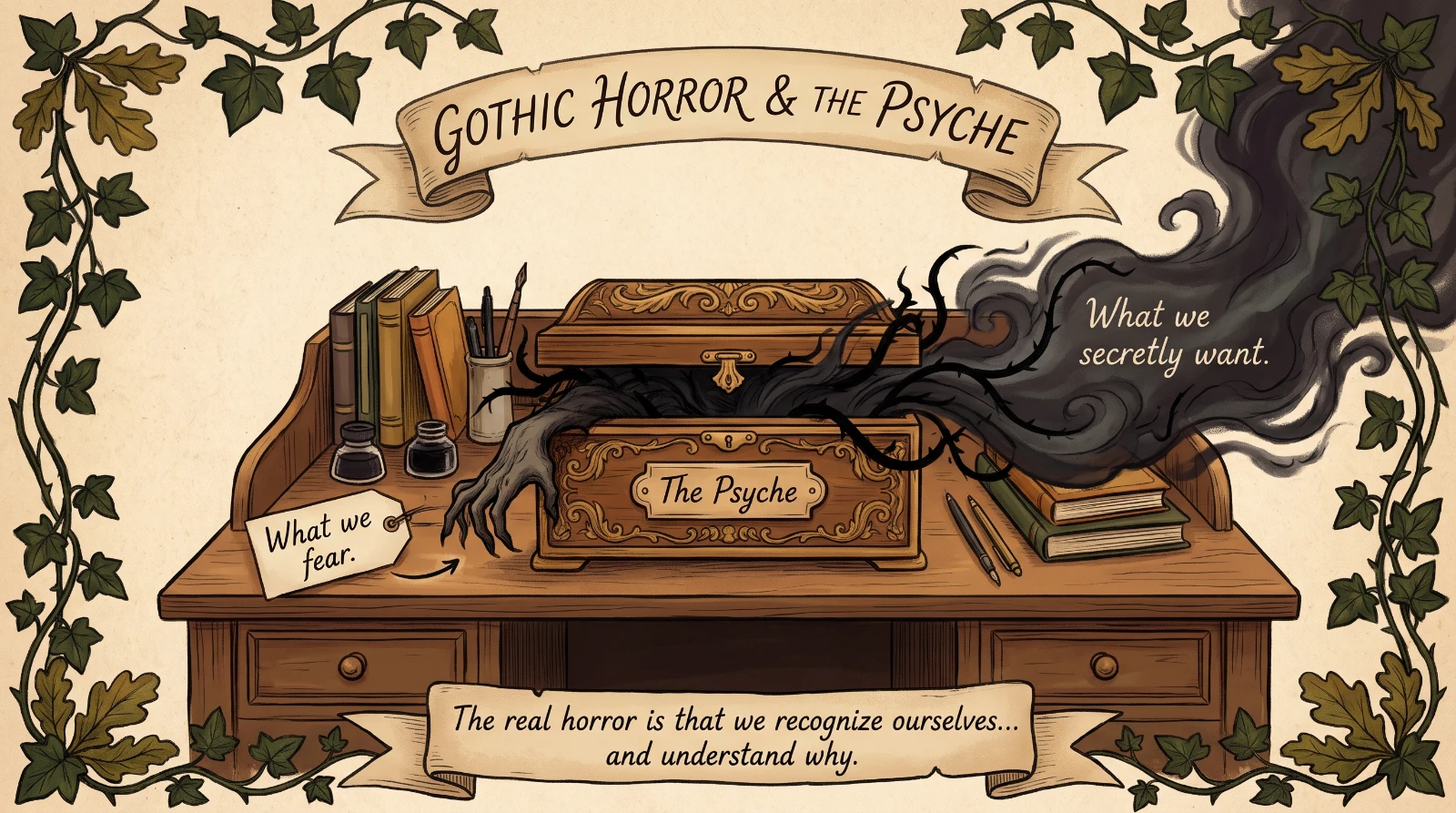
Civilization teaches us to keep these impulses in check so that society can function smoothly. But Gothic horror does exactly the opposite: it gives them a body. By transforming a repressed psychological urge into a physical entity, authors force their characters—and the reader—to confront the darkest corners of their own minds.
Let's look at three case studies across different centuries to see how this psychological mechanism works in practice.
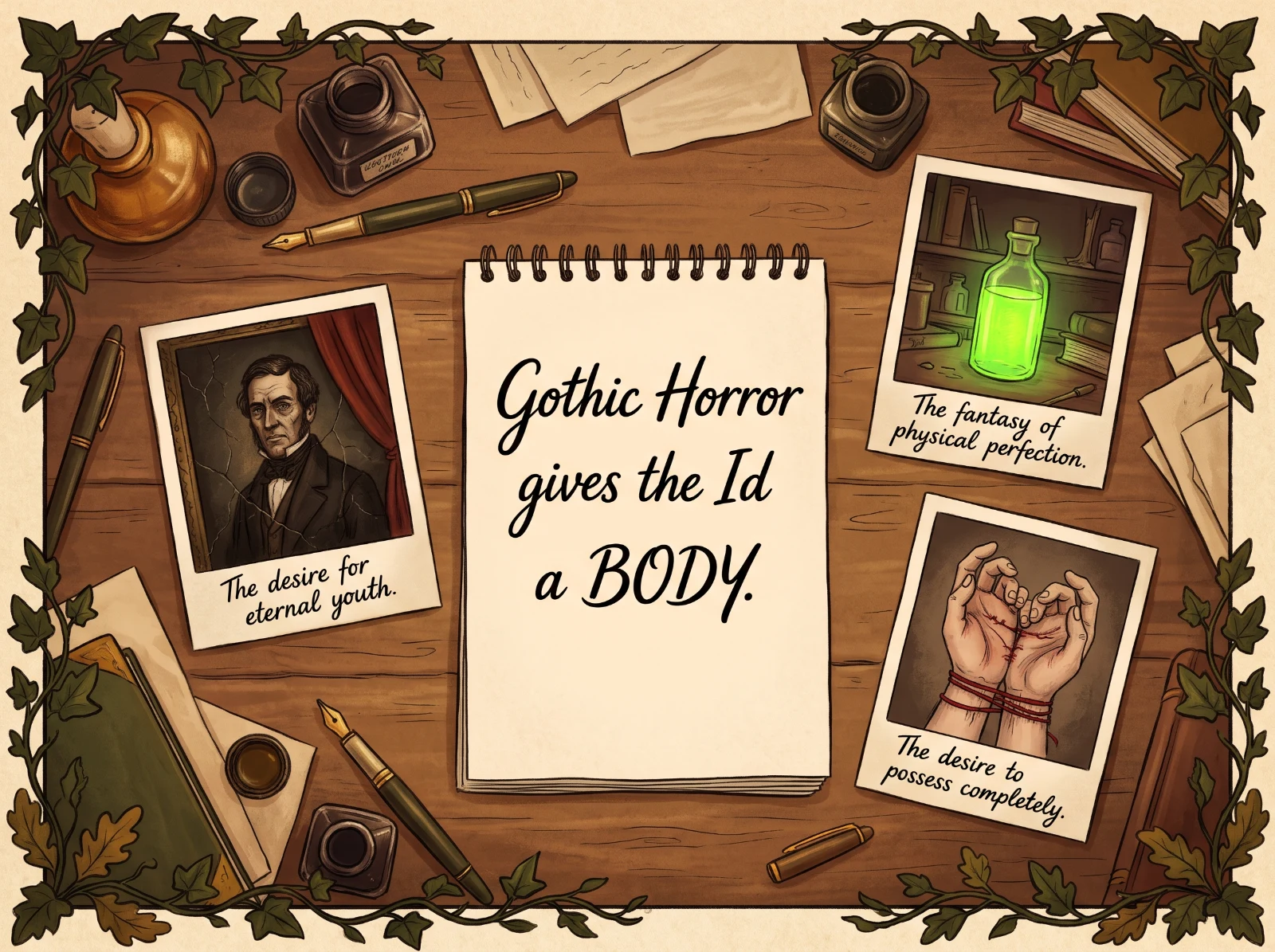
Case Study 1: The Desire for Eternal Youth (The Picture of Dorian Gray)
Take Oscar Wilde’s classic The Picture of Dorian Gray as an example. Dorian wishes to remain young and beautiful forever, while his portrait bears the marks of his moral corruption.
He keeps his beauty while the painting keeps his sins. This is a rather convenient arrangement—until it isn't. Read through a Freudian lens, the painting gives Dorian's unchecked desires a visible form: it grows increasingly monstrous as he pursues pleasure, while his own beauty remains untouched. Yet the portrait is also the conscience he cannot escape.
Case Study 2: The Fantasy of Physical Perfection (The Substance)
Over a century later, Coralie Fargeat’s The Substance (2024), starring Demi Moore, gives the Gothic obsession a gruesome makeover. The protagonist, Elisabeth Sparkle, creates a younger, supposedly better version of herself.
But what begins as a fantasy of perfection becomes an exercise in self-destruction. While Dorian hides his monstrous self in a portrait, Elisabeth gives hers flesh and blood. Though separated by over a hundred years of literary and cinematic history, both texts explore the same fatal vanity. The monster is simply the unchecked pursuit of physical perfection made agonizingly real.
Case Study 3: The Urge to Possess Completely (Together)
The psychological horror extends beyond vanity into our closest relationships. Michael Shanks’s Together (2025), starring Dave Franco and Alison Brie, explores a dynamic where romantic attachment becomes horrifyingly literal.
In the story, two lovers become one. How romantic. And how utterly revolting. Because beneath the fantasy of perfect intimacy lurks a darker desire: to possess another person completely. The film takes the common romantic trope of "two halves of one soul" and pushes it to its grotesque, biological extreme, turning the id's craving for total possession into a body horror nightmare.
The Delicious Irony of the Gothic Genre
When analyzing a Gothic text, ask yourself: what unspoken human desire is this monster fulfilling?
This is the delicious irony of Gothic horror: the monster isn't always what we fear. Sometimes, it's what we want. The most unsettling narratives are those where the boundary between the protagonist and the monster dissolves, revealing that the threat was never external at all.
Perhaps the real horror isn't that monsters exist. It's that we recognize ourselves in them. And worse, we understand why.
Try the reading in a paragraph
Wilde contrasts Dorian’s untouched beauty with the portrait’s growing ugliness, creating a supernatural double that exposes what appearances conceal. Through a Freudian lens, the painting makes the consequences of unchecked desire visible. But the description of it as “conscience” complicates this reading: the portrait also embodies the moral judgment Dorian tries to destroy. The horror comes from his attempt to enjoy pleasure while escaping responsibility.
Try it: Choose one detail from a Gothic text you are studying. Name the technique, then explain the desire or conflict it brings into view.
References & Further Reading
Cohen, Jeffrey Jerome. "Monster Culture (Seven Theses)." Monster Theory: Reading Culture, edited by Jeffrey Jerome Cohen, University of Minnesota Press, 1996, pp. 3–25. Read the chapter.
Freud, Sigmund. The Ego and the Id. 1923. (For further reading on the psychoanalytic concepts of the Id, Ego, and Superego and their influence on literature). Read the text.
Wilde, Oscar. The Picture of Dorian Gray. Lippincott's Monthly Magazine, 1890. Read Chapter XIII.
Fargeat, Coralie (Director). The Substance. 2024. Film details.
Shanks, Michael (Director). Together. 2025. Film details.